
Most students don’t lose marks because their ideas are weak. They lose marks because their English looks rushed:
tense mistakes, missing articles, comma chaos, and run-on sentences. This 2026 guide shows how to use a
free grammar checker to clean up essays, emails, and applications in minutes—without paying for expensive subscriptions.

If you’re a student writing essays, assignments, scholarship statements, or emails to teachers, you already know the pressure:
deadline close, brain tired, and suddenly your writing looks “okay” even when it isn’t. The issue is that your eyes get used to your own draft.
You read what you meant to write—not what’s actually on the page.
That’s why a free grammar checker is not a “luxury tool” for students in 2026—it’s a practical step in a smart workflow.
Think of it like polishing your shoes before an interview. Same person, same talent, but the final impression changes.
It’s written with student life in mind—short routines, real examples, and a clear process you can repeat for every assignment.
No fluff, no confusing grammar terms.
Why Students Still Need a Free Grammar Checker in 2026
Students often assume grammar is only important for “English majors.” In reality, grammar affects every subject—business, IT, science, psychology,
and even project reports. When your writing has frequent errors, the reader spends more energy decoding your sentences than understanding your ideas.
- Clarity improves marks: cleaner sentences help your argument look stronger.
- Faster editing: you save time by catching mistakes instantly.
- Confidence: you submit work feeling sure, not anxious.
- Fair access: students deserve a free option that doesn’t force subscriptions.
In 2026, teachers and employers expect clear English because it’s part of “communication skills.” The good news:
you don’t need perfect English. You need clear English—and a good checker helps you get there.
What a Student-Friendly Grammar Checker Should Do
Not every tool is built for students. Some are heavy, slow, or push paid upgrades constantly. For students, the best tool is simple:
paste text, check, fix, submit.
- Grammar + spelling: fix tense errors, wrong words, basic spelling.
- Punctuation: commas, apostrophes, sentence breaks, quotation marks.
- Clarity: remove awkward phrasing and word repetition.
- Tone help: make emails sound respectful and professional.
- No extra friction: works online without complicated setup.
Avoid pasting passwords, banking details, or highly sensitive personal information into any online checker.
For normal essays, assignments, and emails, most students paste general text safely.
How to Use Grammar.Plus (Fast Student Workflow)
Here’s the routine that works for almost every student—essay, report, email, application, or caption.
It’s simple, repeatable, and doesn’t kill your time.
- Write first, edit later: finish the draft without stopping every minute.
- Take a short break: even 10 minutes helps your brain reset.
- Paste a full section: paragraphs give better clarity suggestions than one sentence.
- Fix the basics first: grammar, spelling, punctuation.
- Then improve clarity: shorten long lines and remove repetition.
- Final read: read one paragraph out loud to catch “weird” lines.
Keep your final step consistent. If you do the same routine every time, your writing improves automatically—because you start noticing patterns.
Try it on your next paragraph (takes seconds)
Paste your text and run a quick check. No complicated setup—just clean, confident English.
✓ Works in your browser • ✓ Quick fixes • ✓ Student-friendly
Most Common Student Mistakes (And How to Fix Them)
These are the mistakes teachers notice fast. Fixing them can instantly make your work look more professional.
1) Run-on sentences
If one sentence contains multiple ideas and feels like it never ends, split it. Your writing becomes clearer immediately.
2) Article mistakes (a, an, the)
Many students struggle because their native language doesn’t use articles the same way. A good checker catches this quickly.
3) Tense inconsistency
If you start in past tense, don’t jump into present tense randomly. Keep your paragraph consistent.
4) Comma confusion
Don’t sprinkle commas everywhere. Use them for lists, after intro phrases, and between clauses where needed.
5) Word repetition
Repeating “important” or “good” again and again makes writing sound basic. Use more precise words based on context.
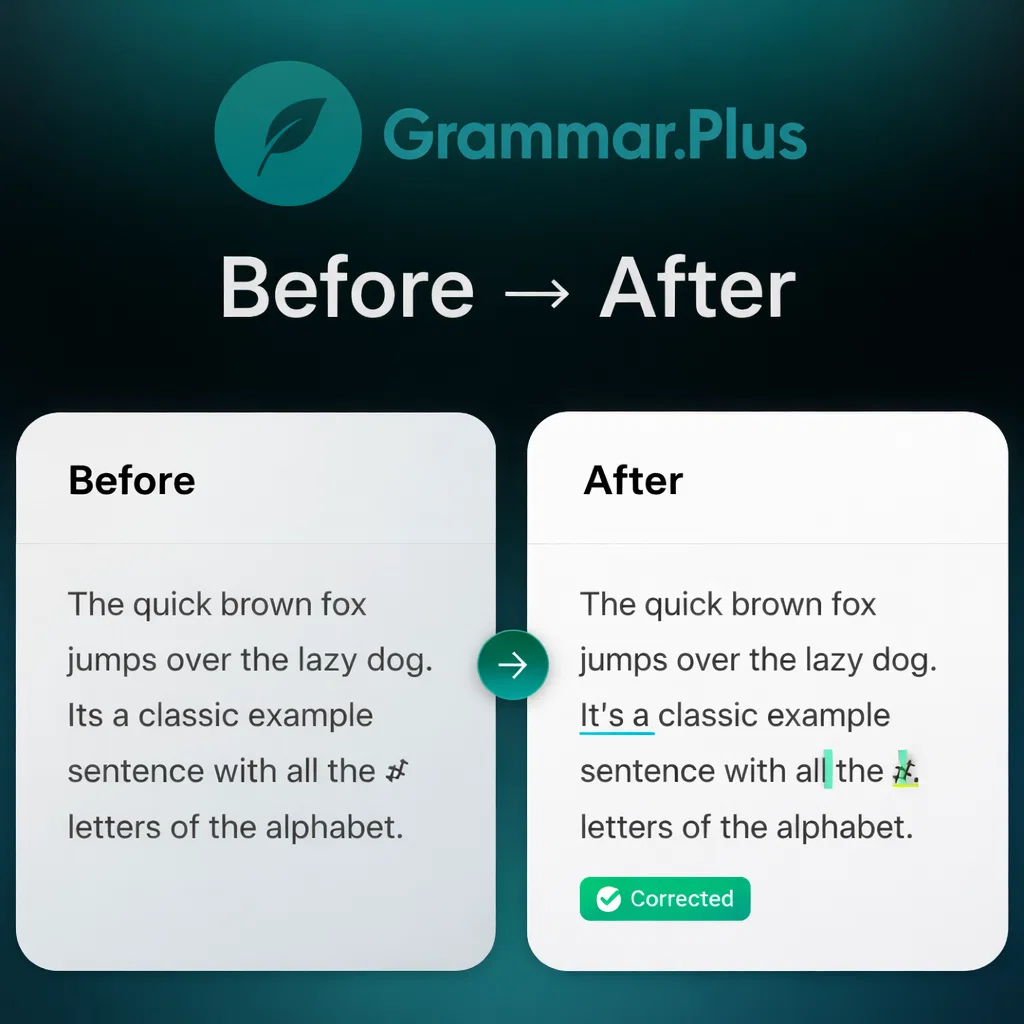
3 Real Examples (Before → After)
Examples help because you can instantly see what changes actually improve a sentence.
Below are realistic student-style lines—and the polished versions.
Example 1: Essay line
This topic is very important because it affect many peoples life and we should take action.
This topic is important because it affects many people’s lives, and we should take action.
What improved: subject-verb agreement (“affect” → “affects”), apostrophe (“people’s”), and smoother punctuation.
Example 2: Email to a teacher
Hi Sir i submitted my assignment yesterday but maybe you didnt recieve it can you check please.
Hello Sir, I submitted my assignment yesterday, but I’m not sure if you received it. Could you please check?
What improved: capitalization, punctuation, spelling (“receive”), and a respectful tone that feels professional.
Example 3: Scholarship/application statement
I am hardworking student who want to achieve my dreams and help my family in future.
I am a hardworking student who wants to achieve my goals and support my family in the future.
What improved: article added (“a”), verb agreement (“want” → “wants”), and cleaner phrasing.
Student Checklist (Copy/Paste Before You Submit)
- Grammar check: tense, subject–verb agreement, sentence structure
- Spelling check: names, topics, keywords
- Punctuation check: commas, apostrophes, full stops
- Clarity check: split long sentences, remove extra words
- Tone check: academic/professional where needed
- Final read: 20 seconds out loud (you’ll catch what eyes miss)
Free vs Paid Tools: What Students Actually Need
You’ve probably heard of premium tools, and some are genuinely good. But most students don’t need advanced features every month.
For essays, emails, homework, and quick checks, a solid free grammar checker handles the essentials.
| Feature | Grammar.Plus (Free) | Typical Paid Tool |
|---|---|---|
| Cost | Free | Monthly subscription |
| Grammar & spelling | Yes | Yes |
| Punctuation fixes | Yes | Yes |
| No login needed | Yes | Often required |
| Best for | Students & quick checks | Long-form professional writing |
If you’re writing a thesis or professional work daily, paid tools may help. But for student life, consistency matters more than premium features.
FAQ (Students Ask These All the Time)
Is using a grammar checker cheating?
In most cases, no. It’s similar to spellcheck—your ideas are still yours. You’re simply improving language clarity.
If your teacher has specific rules, follow them.
Can my teacher detect it?
A grammar checker typically corrects mistakes; it doesn’t replace your thinking. Your voice stays yours if you review suggestions and don’t blindly accept everything.
Does Grammar.Plus store my text?
Grammar.Plus is designed for quick checks without accounts. Data handling can vary depending on how the service runs,
so always review the Privacy Policy for exact details.
Can I use it on mobile?
Yes—open your browser, paste text, run the check, then copy the corrected version back into your document.
Final Word: Your Ideas Deserve Clean English
Your teacher won’t see your effort behind the scenes—only your final submission.
Don’t let small grammar mistakes reduce the value of your work.
A quick check using a free grammar checker can make your writing clearer, more confident, and easier to grade.
Ready to polish your draft right now?
Paste your paragraph into Grammar.Plus and check it in seconds.
✓ Quick workflow • ✓ Student-friendly • ✓ Works in any browser