
Your ideas can be brilliant, but small grammar and punctuation mistakes can make your essay look rushed.
This 2026 guide shows a simple routine to fix errors quickly using a free grammar checker and a final “human-proof” review.
Let’s be honest: most students don’t struggle because they don’t know the topic.
They struggle because their essay looks messy tense changes, missing commas, wrong articles,
and sentences that run for five lines.
The fastest way to fix that in 2026 is to combine two things:
(1) a smart grammar check and (2) a simple manual review.
You don’t need to “learn every grammar rule” overnight just follow a repeatable process.
By the end, you’ll have a step-by-step routine to polish any essay in under 10 minutes without expensive subscriptions.
Why Grammar Mistakes Hurt Essays (Even When Your Research Is Strong)
Teachers and examiners read dozens of essays. When they see frequent errors, they assume one of two things:
either the student didn’t proofread, or the student doesn’t understand the topic clearly.
It’s not always fair—but it happens.
- Errors reduce clarity: your point becomes harder to understand.
- Errors reduce credibility: your writing looks less academic.
- Errors slow the reader: they lose patience quickly.
- Errors cost marks: language and presentation matter in most grading rubrics.
The fix is not “perfect English.” The fix is clear English shorter sentences,
consistent tense, correct punctuation, and fewer repeat words.
Step 1: Identify Your Essay Type (Because Grammar Style Changes)
Before you run any check, quickly identify what kind of essay you’re writing. This matters because tone and structure
change slightly depending on the purpose.
- Argumentative essay: clear claims, strong transitions, confident tone.
- Descriptive essay: vivid language, consistent tense, smooth flow.
- Report / research essay: formal tone, precise wording, accurate referencing.
- Reflection / personal essay: natural voice, but still clean grammar.
If you’re unsure, keep it formal and clear. You can always simplify later.
Step 2: Fix the “Big 5” Errors First (The Ones That Scream “Student Draft”)
These five mistakes appear in student essays again and again. If you fix them,
your essay instantly looks more professional.
1) Tense switching
If your paragraph starts in past tense, keep it in past tense unless there’s a strong reason to switch.
Example: “The study was conducted…” shouldn’t suddenly become “The study shows…” in the next sentence
(unless you’re describing general facts).
2) Missing articles (a/an/the)
Urdu speakers often skip articles. In academic writing, articles add clarity:
“a student,” “an assignment,” “the professor,” “the research.”
3) Run-on sentences
If a sentence contains three ideas, split it. A reader understands your argument faster.
4) Comma overload
A comma is not a “pause wherever you feel.” Use commas for lists, introductory phrases, and clause separation.
5) Repetition
Repeating “important,” “good,” “bad,” and “very” makes your writing sound basic.
Replace with precise words based on context (essential, effective, harmful, significant).
Step 3: Use a Free Grammar Checker the Smart Way (Not the Lazy Way)
A free grammar checker is most powerful when you paste your text in a structured way.
Students often paste one sentence, fix it, paste another, fix it—this wastes time and misses clarity improvements.
- Paste full paragraphs (not single sentences).
- Fix grammar + spelling first (basic errors).
- Then fix punctuation (commas, apostrophes, sentence breaks).
- Then improve clarity (awkward phrasing, repetition, wordiness).
- Finally do a human read (tools help, but you finalize).
Paste your essay paragraph and check it in seconds
Use Grammar.Plus to clean grammar, spelling, punctuation, and tone quickly—perfect for student essays and reports.
✓ No complicated setup • ✓ Quick checks • ✓ Student-friendly
3 Essay Before → After Examples (Real Student Style)
Let’s look at typical lines that appear in essays—and how small fixes transform clarity.
Example 1: Research sentence
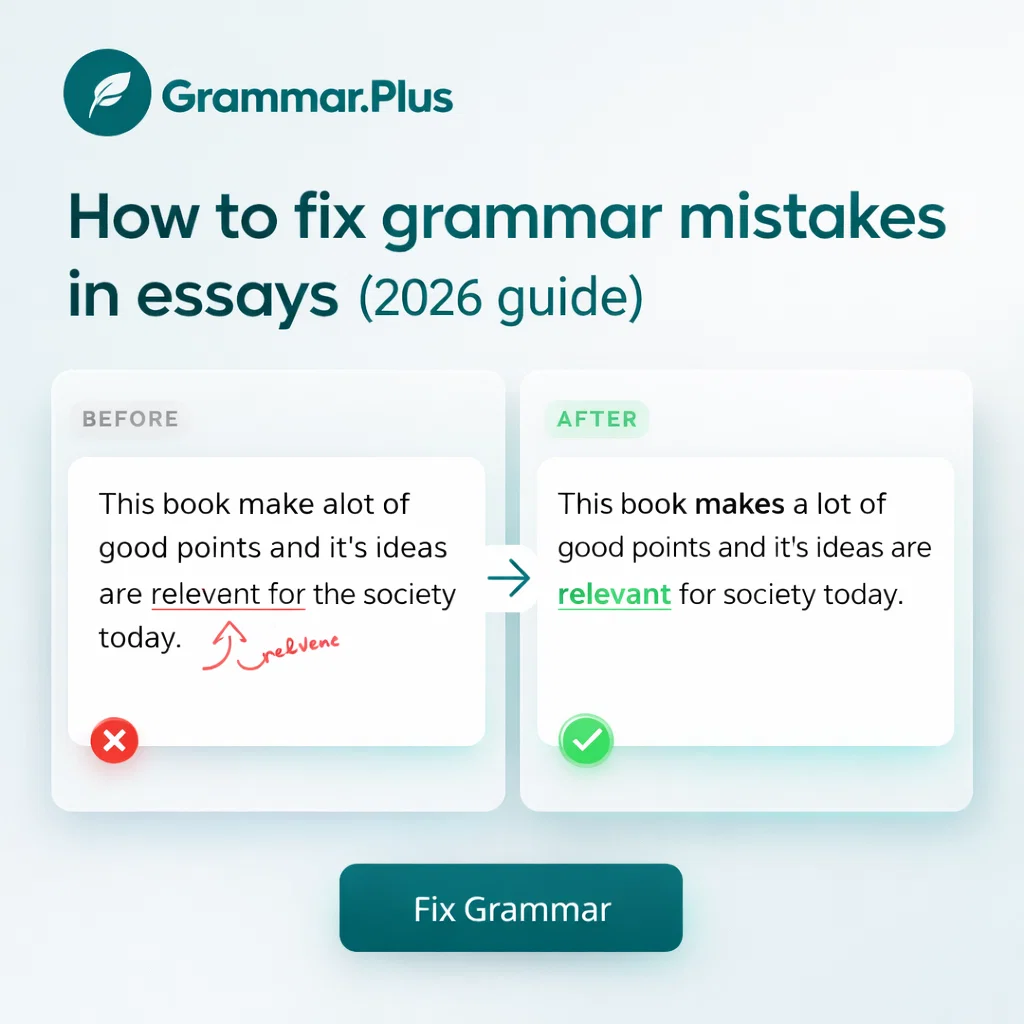
This research show that social media have bad effects on students and it make them distracted in studies.
This research shows that social media can negatively affect students and distract them from their studies.
What improved: subject–verb agreement (show → shows), clearer wording, smoother structure.
Example 2: Argument sentence
In my opinion the government should take action because pollution is increasing, people are getting sick.
In my opinion, the government should take action because pollution is increasing and people are getting sick.
What improved: comma placement + fixed comma splice by connecting the ideas properly.
Example 3: Conclusion line
To conclude, this topic is very important and it is very important for our future and very important for society.
To conclude, this topic is important for our future and has a direct impact on society.
What improved: repetition removed, sentence tightened, impact stronger.
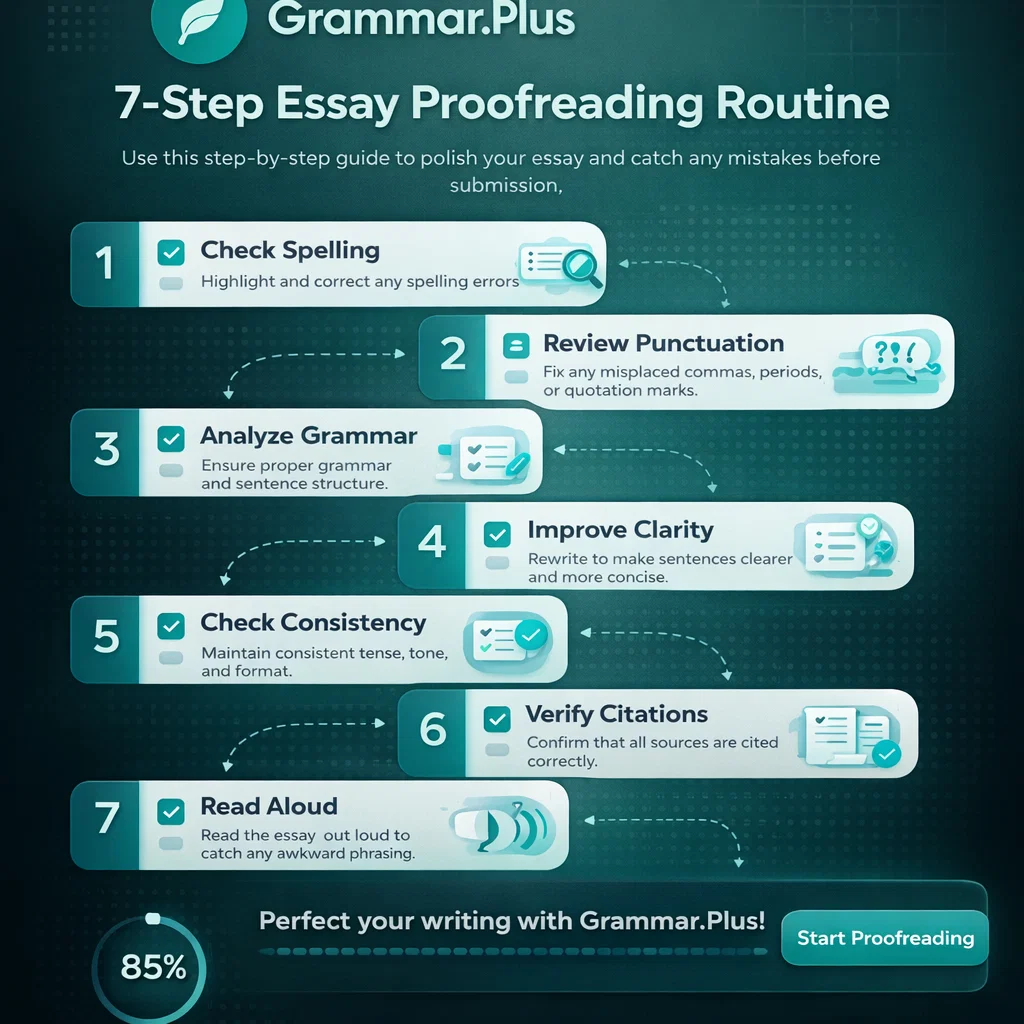
The 7-Step Essay Proofreading Routine (Copy This)
This routine is designed for real student life—fast, repeatable, and effective.
Use it before every submission.
- Step 1: Finish your draft first (don’t edit while writing).
- Step 2: Take a 10–15 minute break.
- Step 3: Read once and fix obvious mistakes manually.
- Step 4: Paste full paragraphs into a free grammar checker.
- Step 5: Fix grammar + spelling first, then punctuation.
- Step 6: Improve clarity (shorten long sentences, remove repetition).
- Step 7: Do a final read aloud (one paragraph is enough).
If your essay feels “too long,” it’s often not length—it’s sentence structure. Shorter sentences increase clarity without reducing meaning.
Common Essay Grammar Questions (FAQ)
Should I accept every suggestion from a grammar checker?
No. Use the tool as a guide, then apply fixes that keep your meaning correct. If a suggestion changes your idea, rewrite the sentence in your own words.
How many times should I proofread?
Ideally two passes: one tool-based check and one short human read. Most students don’t need five rounds—just a consistent process.
What should I avoid pasting online?
Avoid passwords, financial details, and extremely sensitive personal information. Essays and general assignments are typically safe for most students.
Final CTA: Make Your Essay Look Like an A-Grade Submission
A clean essay is easier to read, easier to grade, and easier to respect.
Your ideas deserve clear English—especially when deadlines are close.
Check your essay paragraph now
Paste your text and fix grammar mistakes in seconds.
✓ Fast • ✓ Clear • ✓ Built for students